What is IPOR Fusion? A Technical Overview

IPOR Fusion is a yield optimization framework for automated execution of smart asset management on-chain, saving users time and effort. It is an unopinionated and customizable infrastructure fund managers can use to deploy assets on-chain while implementing custom algorithms off-chain.
Smart contracts ensure transparent allocation of assets on-chain, while off-chain agents (generally called Network Keepers or Alphas in the context of Fusion) allow strategists to design custom algorithms or implement logic for allocating and rebalancing assets.
The architecture is modular, built with flexibility and composability in mind. It consists of three core elements:
🔶 Fusion Vaults (ERC4626 compliant) accept deposits and put capital to work by deploying it in a series of strategies that will be dynamically managed by Alpha Keepers (Alphas for short);
🔶 Fuses are small contracts that are attached to Fusion Vaults to perform atomic actions on integrated protocols;
🔶 Alphas are the off-chain agents or bots responsible for maintaining the strategy operations of a specific vault. They run off-chain automated software to optimize asset allocation by calling functions on Fuses.
The ability to add and remove fuses is what makes Fusion Vaults a key component of a yield seeker’s toolbox, allowing fund managers to adapt and thrive in a variety of market conditions.
Fuses can be added and removed at will, while the actual yield algorithms live off-chain and can be adjusted at any time. Fuse-based design is not only flexible but also safe. Fuses hold no balances and all assets or liabilities are owned directly by the vault.
Each individual vault can maintain its own risk profile without affecting others.
This is instrumental when vaults are involved in credit markets and must maintain individual LTV ratios or anywhere else where one might be subject to liquidation.

1️⃣ Value Proposition
Fusion addresses the need for automation of both simple and complex DeFi strategies in a transparent permissionless manner.
Thanks to the unique architecture, vaults can use leveraged positions without sharing the risk with other vaults. Some of the example strategies possible to be created and automated are:
⚡ Asset allocation to primary credit markets (AAVE/Compound/Euler/Morpho/Fluid etc) as well as secondary markets (Yearn, MetaMorpho, etc.);
⚡ Leveraged looping — with the use of flash loan or by using dedicated leveraged borrow functionalities provided by some of the credit markets;
⚡ Spot/Perp trading to capture basis (similar to Ethena).
Automation for the vaults includes not only liquidation protection but also active portfolio management and yield optimization that considers efficient capital allocation, gas price, slippage, and even trends and market correlations.
Because the logic for automation lives off-chain, it can leverage complex data structures, heavy computation, and even AI.
At the same time, fuses limit what the Alphas can do, preventing arbitrary transactions from being executed.
Economies of scale:
- Multiple LPs can pool their assets into the vault and save gas costs when interacting with DeFi protocols;
- A single fuse can be used by multiple vaults. The more fuses the more options each vault has to seek yield;
- Alphas can automatically support the integrated fuses for all the vaults.
2️⃣ Architecture Overview
The goal when designing IPOR Fusion architecture was to maximize flexibility while ensuring transparency and security.
Those requirements led to a structure, where ERC4626 vaults can interact with external protocols via atomic fuses.
Only the actions defined in the Fuse can be executed by an Alpha. This ensures that no arbitrary functions can ever be run to manage the assets deposited in the vault.
From the security perspective, it is crucial that automation is constrained by predefined rules. Otherwise, malicious transactions could be executed and only discovered once they are completed.
Various strategies can be created depending on which Fuses are connected and how they are configured at the vault level. Because all Fuses share a common interface, existing vaults can be integrated with an ever-expanding portfolio of Fuses.
The infrastructure is flexible enough to allow for the development of both:
- Low-risk stablecoin funds;
- High-risk leveraged farms.
The illustration below demonstrates how various Fusion elements work together:
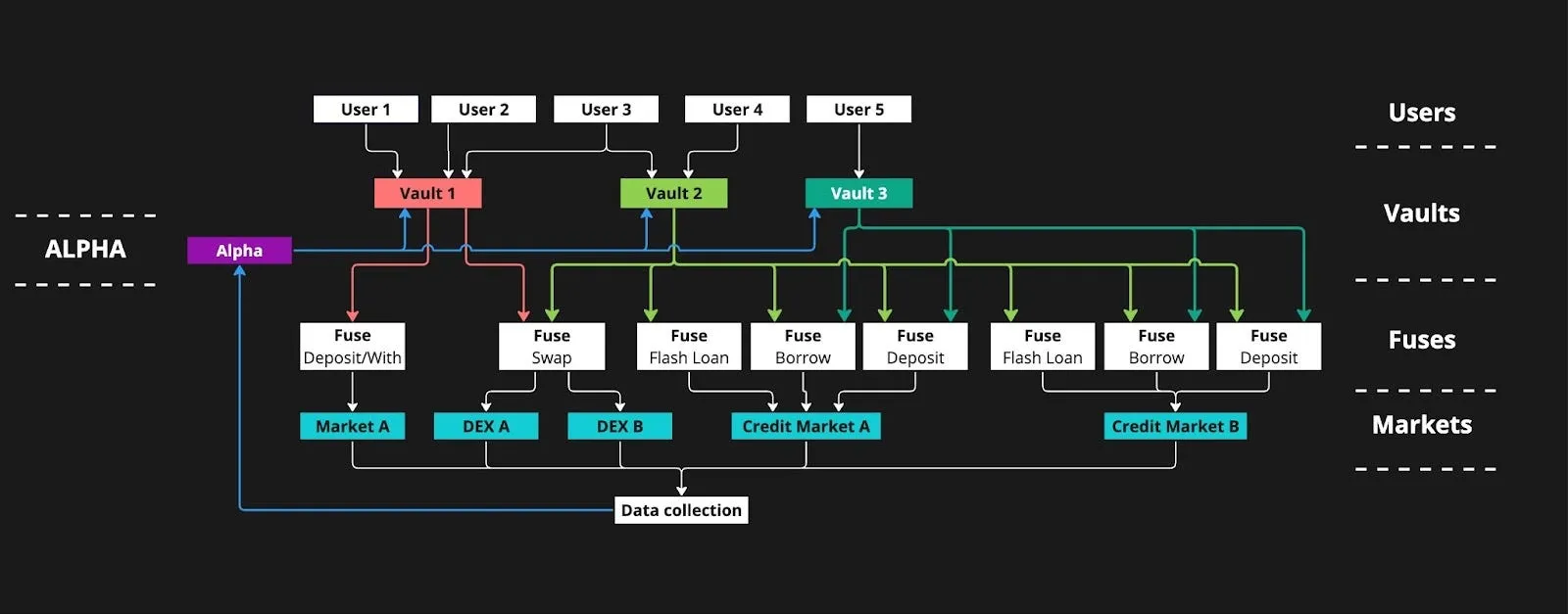
- Users can deposit assets in multiple vaults.
- Each vault is connected to various markets via Fuses.
- An Alpha monitors the markets with connected Fuses so that, when a vault is configured with compatible Fuses it can instantly be managed. The Alpha decides on the allocation of the assets across connected markets according to an appointed strategy (read below) and prepares transactions that can be executed on the vault.
3️⃣ Challenges
Automation of strategies in DeFi is not exactly a new thing. Thus far, however, there has been a need to make some compromises when automating.
- If you want to be efficient, you need to sacrifice the transparency.
- If you need permisionlessness, then you need to sacrifice either transparency or flexibility.
- If you want transparency, you need to compromise on performance and the amount of computation you can afford.
- Greater flexibility calls for compromise on security.
- Speed of development means you must compromise on transparency and possibly even security.
IPOR Fusion’s approach is to limit what actions can be taken by the Automation. Instead of allowing any kind of interaction between the vault and an external market, Fusion opts for the Fuses as a means to enforce security.
This supposed limitation of flexibility is overcome by creating a Fuse that can provide any desired functionality safely. This approach allows different vaults to interact with the same protocols in different ways; limiting the risk and exposure to levels acceptable by the liquidity providers (LPs).
For example, one vault may be interested in depositing blue chip tokens to AAVE but not borrowing, another one may want to borrow and lever up using exotic assets as collateral. The first would use AAVE deposit Fuse, the second one would utilize AAVE borrow and DEX Fuses.
4️⃣ The Nature of the Fuse
Fuses are one of three pillars that Fusion stands on. Fuses are the remedy providing permissionlessness, transparency, security, and speed of development.
All Fuses must meet the following requirements:
- Stateless — They have no memory, no configuration, and they store no data. Thanks to that they can be used by multiple vaults at the same time without the risk of them interfering with one another.
- Non-upgradable — Fuses, by nature, are simple contracts that can not be altered. That assures Vault’s actions can be trusted and Fuses can be shared without additional risk. Should the destination market’s ABI change, a new Fuse needs to be deployed.
- Standard ABI — One of the tasks of the Fuse is to bring the interface of the market down to a standard ABI. Fuses implement two core functions: Enter and Exit that, depending on context deploy or withdraw assets, take a loan or repay it, etc. On top of that some Fuses can implement instantWithdraw — a function with predefined params to pull the assets from the market without the need for Alpha’s interaction. This is relevant if the Vault allows for instant redemptions of shares.
- Configurability — because Fuses are stateless, any configuration is delegated to the vault. The Fuse is built to accept the calls with the configuration.
Fuses can be built and used by anyone.
The IPOR DAO will provide a testing framework (see below) along with a DAO governance process that will help expedite the process of verifying the security of newly created Fuses so that the owners of the existing vaults can focus on expanding and evolving the strategies as the DeFi landscape evolves and new possibilities appear.

5️⃣ How do Fusion Vaults Work?
Bootstrapping — Basic Configuation
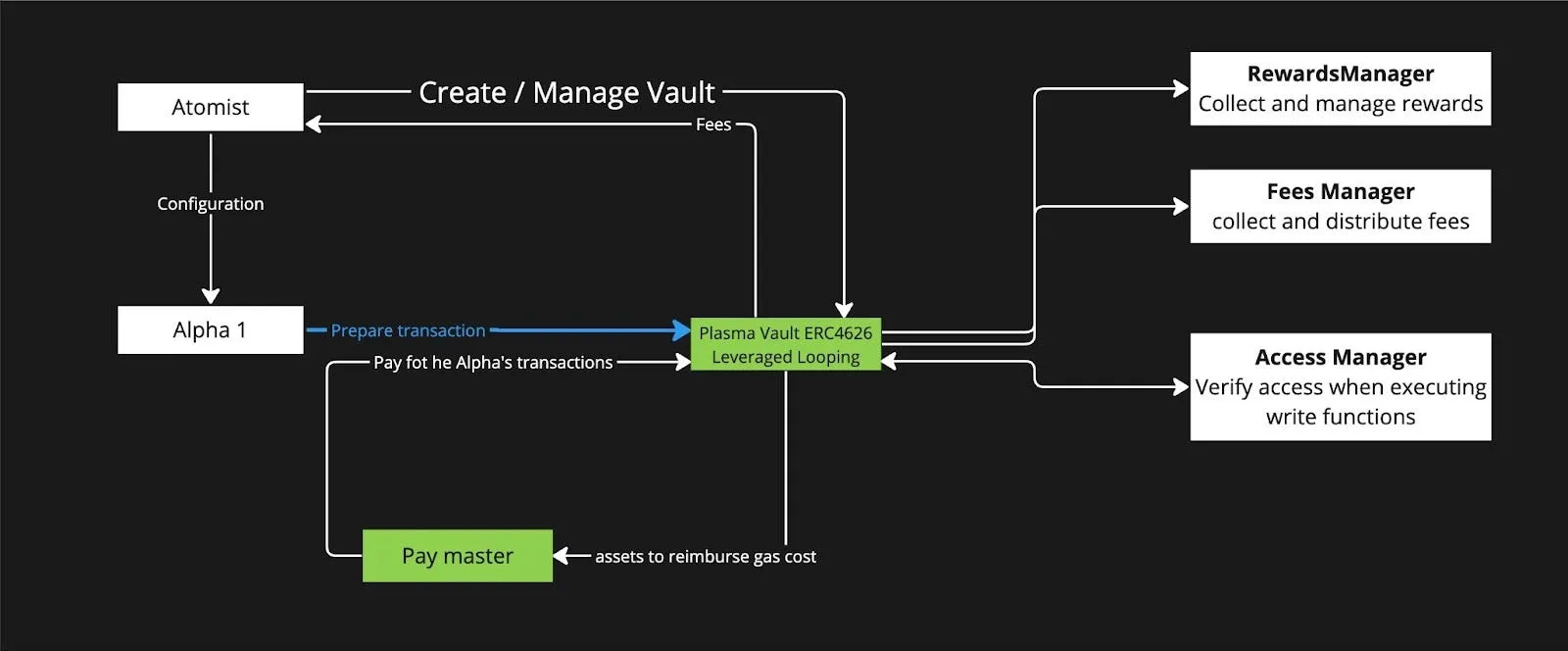
Atomists can use the IPOR Fusion Factory to create a vault by configuring and deploying the necessary smart contracts.
🔸 Define Permissions
Fusion vault can either be open or restricted. You, as an Atomist can decide, who can deposit tokens to your vault. There are 2 options:
- Open vault — anyone can deposit.
- Restricted vault — only user(s) on the predefined whitelist can deposit
🔸 Select Denomination Asset
The asset that can be deposited or withdrawn from the vault. All accounting and APRs are calculated using this asset as a reference.
🔸 Set the Timelock
Any configuration change after the vault creation would be subject to a waiting period before the changes would be enforced.
🔸 Choose a redemption strategy
- Instant — useful if you need to be able to withdraw the funds without notice. For example, when your Vault is holding idle assets from another protocol.
- Asynchronous — shares can be redeemed in two steps. First: request redemption allowing Alpha to prepare the assets, and second: actual redemption.
🔸Select Fuses and Define the Strategy
Depending on which actions you want to allow Alpha to perform, you will have to select a matching set of Fuses. For example: if you would like the vault’s assets to be deposited to AAVE V3 and Compound V3; you would need AAVE V3 and Compound V3 deposit Fuses. If you would like Alpha to also be able to leverage loop on those credit markets you would additionally need a Flash loan Fuse (special kind of Fuse not discussed in this article), Swap Fuse (special kind of Fuse not discussed in this article), and Fuses to take a loan on both AAVE and Compound. With this array of Fuses, Alpha will be able to lever up, deleverage, and rebalance between 2 markets. If the looping is not profitable it can revert to depositing collateral without taking loans.
The second step in defining a strategy is setting the configuration of the Fuses through the Fusion Vault. Settings related to Fuses are fairly limited and should be treated as hard limits used for validations. For example: The Atomist can define the maximum level of deposit to a particular market. If the level of deposits is met, then Alpha can no longer make allocations to that market, and it can only decrease the size of the position.
🔸Appoint and Configure an Alpha
IPOR Fusion is an automation-first type of solution, intended to be managed via a dedicated engine. IPOR Labs-operated Alphas can be used along with any other Alphas operated either by yourself or a 3rd party that you trust. You can also appoint an externally owned account (EOA) or multisig as Alpha however that means the vault would be managed manually.
🔸Appoint a Paymaster
In case Alpha is run by a party not directly associated with the Atomist and operates in a high-gas-cost environment such as Ethereum mainnet, the Alpha is limited to preparing a transaction, the execution and gas payment are outsourced to the so-called paymaster.
🔸Set Fees
Fusion can facilitate charging two kinds of fees:
- Management — charged as an annualized percentage of assets under management (AUM).
- Performance — charged as a percentage of the positive yield generated by the vault
Both kinds of fees can be split between the Atomist and IPOR DAO. Management of fees is done by a dedicated contract deployed when creating a vault — FeesManager.
6️⃣ Example Use Cases
🔸 TradFi Fund
- Creates restricted vault by whitelisting only one account that is allowed to deposit.
- Keeps the vault private by opting out from showing the Fusion Vault on the IPOR Fusion web interface.
- Selects a list of Fuses to connect to blue-chip primary markets.
- Selects IPOR Labs Alpha and sets the configuration to run a conservative yield optimization strategy.
🔸 DAO Treasury
- Creates a restricted Fusion Vault by whitelisting only one account that is allowed to deposit.
- Selects the “instant withdraw” option.
- Opts in for making the vault visible so that protocol users can verify how the assets are allocated in real time.
- Selects a list of Fuses to connect to blue-chip primary markets.
- Selects IPOR Labs Alpha and sets the configuration to run a conservative yield optimization strategy.
- Sets low or no fee.
- Implements timelocks and governance layer.
🔸 DeFi-native manager
- Creates an open Fusion Vault.
- Opts in for making vault visible so that LPs can verify how the assets are allocated in real-time.
- Selects a list of Fuses to connect to primary credit markets, DEXes and Perp markets to run looping or hedging strategy.
- Sets competitive management and performance fees.
- May consider running their own Alpha.
- Implements timelocks without governance layer.
- Advertises the vault and its performance to grow the AUM.
- Frequently changes the Fuses and adapts the strategy to stay on the forefront of DeFi evolution.
7️⃣ Updating the Configuration
The general rule is that all the settings can be changed by the Atomist but there are a few exceptions:
- The denomination asset, symbol, and name can’t be changed.
- The redemption strategy is not changeable.
- If the vault has been made open to users, it can not be restricted after.
All the changes in the opened vaults can be subject to the timelock before coming into effect.
It’s worth mentioning that each edition of the configuration emits an event that is picked up by the Alpha appointed by the vault allowing it to reconfigure itself to the new params. Any alpha-specific settings can be rolled into this event so that they can live on-chain and be fully transparent.
8️⃣ Executing Transactions
Transaction preparation and execution sets the IPOR Fusion automation apart from other solutions. Each Alpha appointed to manage the vault needs to implement several components:
- Transaction SDK — to be able to integrate with the Vault and Fuses easily
- Decision logic
- Blockchain monitoring
The most complex is the decision logic. Initially, IPOR DAO will provide the set of Alphas that will integrate all the Fuses created by the DAO. Consequently, to get the IPOR Alpha to start managing the vault all it will take will be to bootstrap the vault with a collection of Fuses and authorize the Alpha to oversee the vault.
In the future, there will be an open marketplace connecting Atomists and Alphas. The fee share at the management level may vary depending on the complexity of the logic.

9️⃣ IPOR Labs Alpha
The first type of Alpha available to all IPOR Fusion users will be the yield-optimizing Alpha. This algorithm takes into consideration the following data:
- Cost of gas (negligible on L2s) and gas cost trends to ensure it doesn’t operate during gas price peaks. Gas price consideration is critical mainly for smaller vaults where efficient rebalancing may be so expensive, that potential earnings would be erased by the cost of transacting. In many cases, the Alpha would choose not to rebalance when it would consider potential benefits not worth the gas expenditure.
- Effect of its actions when interacting with the external markets (aka slippage). This is especially important for larger vaults because of the sheer size of assets they can move. In some cases, vaults can be large enough to completely change the landscape by efficiently allocating assets.
- Historical credit market rate trends (with regards to Fuses connecting to credit markets).
Depending on settings that are individually set per vault, the Alpha will behave differently. Its goal, however, is always to seek the optimal risk-adjusted yield for the deposited assets.
It will run simulations of the most effective asset allocation and prepare rebalancing transactions. If, for example, an Alpha is managing a vault connected to 3 credit markets, it may deploy all assets to one market, or split it between two or all three, depending on which configuration will yield the best risk-adjusted result. Every time the market moves, the Alpha will reassess its decision.
Transactions are always limited to the Fuses that are connected to a particular vault, so no arbitrary code can ever be executed.
1️⃣0️⃣ Claiming and Managing Rewards and Airdrops
It may happen that the vault will accrue some rewards by interacting with protocols. In this case, there must be a way to claim the rewards and utilize them according to the Atomist strategy. In IPOR Fusion, the strategy to deal with the tokens is delegated to the rewards manager — a smart contract responsible for managing rewards claimed by the vault.
1️⃣1️⃣ Security
🔸 Access management
IPOR Fusion uses dedicated access management for every function on the vault.
When the function is executed, additional validation is made with the help of an access management contract. This contract stores the method signature and list of addresses authorized to use it. This allows for a very flexible, robust, and extensible access control.
🔸 Timelocks
Some vaults, especially those that allow open participation, may want to enforce a timelock when changing settings that could affect the funds deposited by LPs. When bootstrapping a vault, the Atomist has the option to define the timelock period. This way, users have time to move their funds before changes come into effect.
To further improve the timelock governance the IPOR DAO is considering collaboration with Aragon to bring a solution where open vault participants would have a say in the process of changing parameters.
An example of such implementation is the Steakhouse MetaMorpho vaults governance:
Steakhouse MetaMorpho Vaults are upgrading their guardian setups to fully trustless
🔸 Testing and Auditing
IPOR Fusion is subject to rigorous audits. This article will be updated as the reports become available.
💡 Perhaps more interesting is the approach that IPOR Fusion takes with regard to validating Fuses. ⬇️
As more Fuses are developed by a more diversified pool of developers, reviewing Fuses will become more burdensome and prohibitively expensive. Auditing all the Fuses, and by proxy the connections that vaults can establish with external protocols, would be difficult and costly to scale. It is then imperative that an alternative process for reviewing and validating Fuses is established early on. This approach is vital to the longevity and security of Fusion.
Part of the infrastructure of IPOR Fusion is the framework of automatic Fuse testing that includes fuzz testing and more traditional unit testing. Each Fuse, because of its limited scope and standard interface, can be automatically verified to speed up the review process before it can be integrated by the keepers and receive the stamp of approval by the IPOR DAO.
🔸 Preventing Sandwich Attacks
A sandwich attack is an attempt to profit from the order of executing transactions on the blockchain. Specialized players can watch transactions pending to be executed on the blockchain and try to wrap them in their own transactions to extract value. This is possible because it is ultimately up to the miner of the block to arrange transactions.
An example of such type of attack would be to watch for transactions that add liquidity to the ERC4626 vault without minting additional tokens. This would happen when vault-owned liquidity rewards would be sold and proceeds distributed to the shareholders of the vault. In this case, the attacker could slide his deposit transaction just before the transfer of the tokens to the vault and execute a withdrawal just after additional assets were transferred. In this way, they would participate in the distribution of the rewards without the need to park their assets even for a second. This attack can be easily carried out with a flash loan, effectively eating all the proceeds of the vault and leaving the shareholders empty-handed.
The easiest way to mitigate this type of attack is to make it unprofitable by implementing deposit or withdrawal fees or outright preventing permissionless deposits. Both solutions are not ideal as they limit access to the vault.
IPOR Fusion provides an additional, less blunt approach to curb the sandwich attack.
- First: the atomist can prevent vault deposits and withdrawals from taking place in one block to easily prevent flash loan usage
- Second: proceeds from selling the rewards, or any other asset injections can be piped through a dedicated contract that will linearly “fade in” the amount over a defined period. This way the attack is rendered completely ineffective.
🔥 Conclusion
IPOR Fusion is a composable, flexible, and secure way to automate even complex DeFi strategies. It brings innovative solutions and economies of scale. It allows DAOs to earn yield on idle assets, asset managers to build their bespoke trading strategies for DeFi users, and even TradFi funds to manage their clients’ assets in private vaults.
Initially, IPOR Fusion will be used to manage IPOR Protocol assets, and then it will be progressively opened up to allow permissionless creation and management of vaults.
To make sure you don’t miss any news about IPOR Fusion make sure you follow the official X Account. If you want to reach out to the team and join the community you can use Discord.