Institutional Vaults: How Regulated Capital Reaches Aave, Morpho and 40+ Protocols

Regulated capital is looking for a way into the onchain economy, and for the qualities that make it worth entering: transparency, programmable access, composability, and primitives that have no equivalent offchain.
The onchain opportunity set is substantial and still thinly contested, with few regulated entities operating onchain at scale.
Entities like BitGo and 21Shares already reach those venues through the Fusion vault infrastructure.
This article explains in detail how institutional entities access the DeFi economy and its popular liquidity venues like Aave, Morpho and Spark through an access point that meets their regulatory expectations, standards for control, mandate and verification.
How institutional vaults control access, authorized venues and assets, and accounting
Institutional and regulated entities choose Fusion vaults because a vault lets its operator define exactly what can happen before any capital enters, with permissions and accounting enforced onchain. In practice, that definition covers key pillars.
Who can act (RBAC)
Only assigned roles can operate the vault, and each role’s authority is fixed onchain.
Example: an operator, whether a human or an AI agent, can rebalance positions without ever being able to move client funds out of the vault.
Who can access
The vault defines who is allowed to deposit in the first place. Access can be open, or restricted to addresses that meet defined requirements, enforced onchain at the point of entry.
Example: a vault can be permitted only to wallets that have passed KYC or KYB checks, so a regulated institution can meet its own access requirements before any capital enters.
Which actions are allowed
The vault permits a specific set of operations and nothing beyond them.
Example: a cbETH looping strategy can supply cbETH as collateral, borrow ETH against it, swap that ETH back into cbETH, and repay the exact actions the loop needs, while any action outside that set stays unavailable.
Which markets can be reached
The vault is scoped to named markets in advance.
Example: a vault can be permitted to reach a specific Aave or Morpho market and nothing else, so it cannot allocate into a venue it was never configured to use.
How every position is accounted for
Each position the vault holds, collateral, debt, or receipt tokens, is tied back to onchain accounting.
Example: in a leveraged cbETH position, the cbETH collateral and the ETH debt are each valued onchain, so the vault’s worth stays verifiable, down to the last decimal.
An institution can inspect the strategy before committing to it.
Two ways institutional capital reaches onchain markets
Regulated and institutional entities reach onchain venues through Fusion vault infrastructure in one of two ways, and the right one depends on how a firm prefers to operate.
Access through a regulated partner (MiCA-authorised)
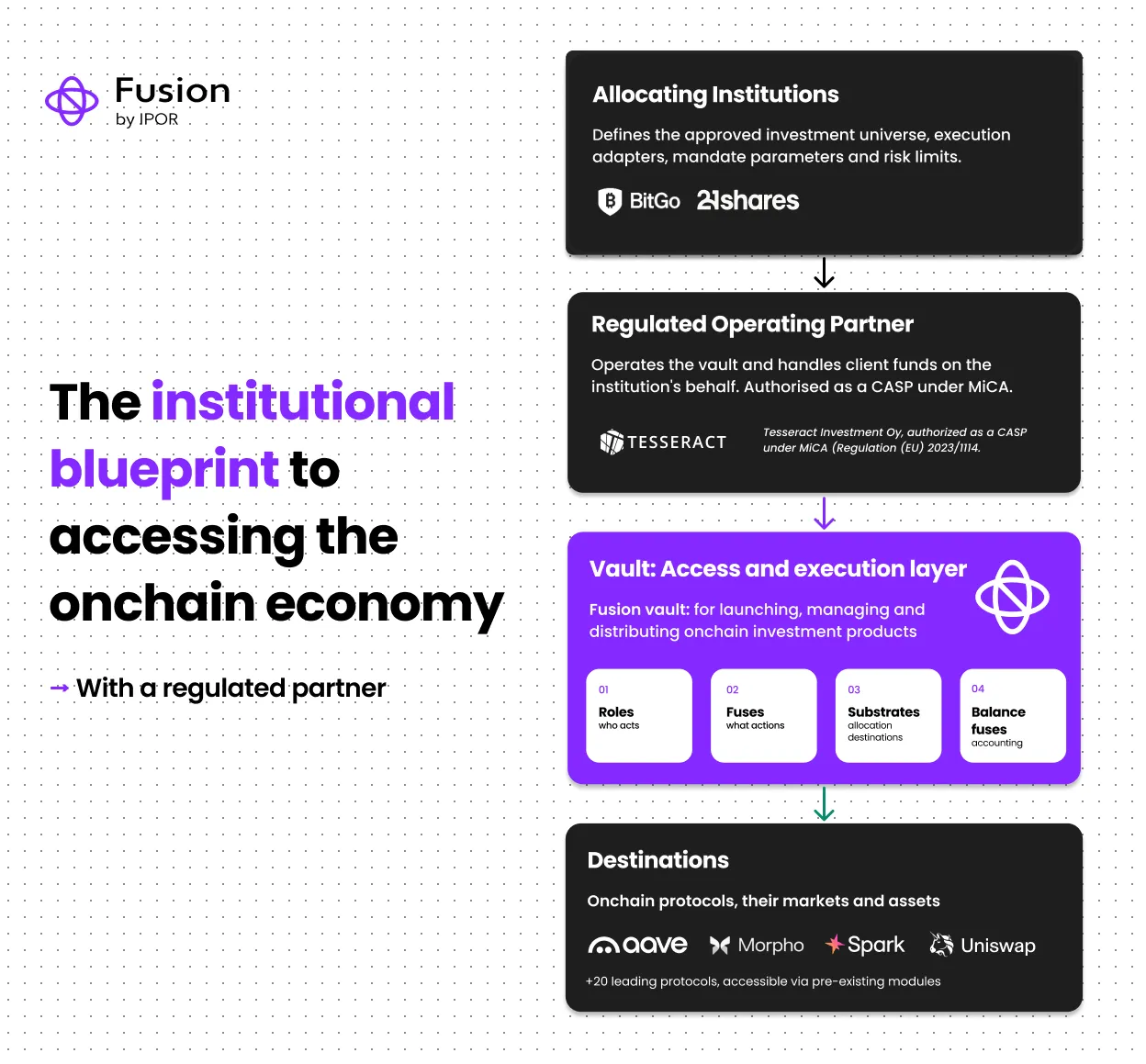
Many institutions prefer a partner authorised to handle client funds and vault operations on their behalf. For them, a regulated partner is the path.
Tesseract, a MiCA-authorised entity, offers Dedicated Client Vaults built on Fusion, structured to meet EU standards such as the separation of client assets. Tesseract handles the vault setup, the strategy configuration, and the capital deployment, while the institution keeps its exposure inside a regulated perimeter.
BitGo and 21Shares are among the institutions reaching onchain markets through this route.
“Working with the IPOR Fusion team has been an exceptional experience. They bring a deep level of technical expertise and market understanding […] The result is a solution that is not only truly institutional-grade, but also at the forefront of where the market is heading. They have been a key partner in helping us bring our vault vision to life, and couldn’t recommend them more highly.”
 $500M+ AUM, MiCA-Authorised
This path suits firms that want onchain exposure with a regulated partner carrying the operational load. It is one of the routes available on Fusion.
Direct access for in-house teams
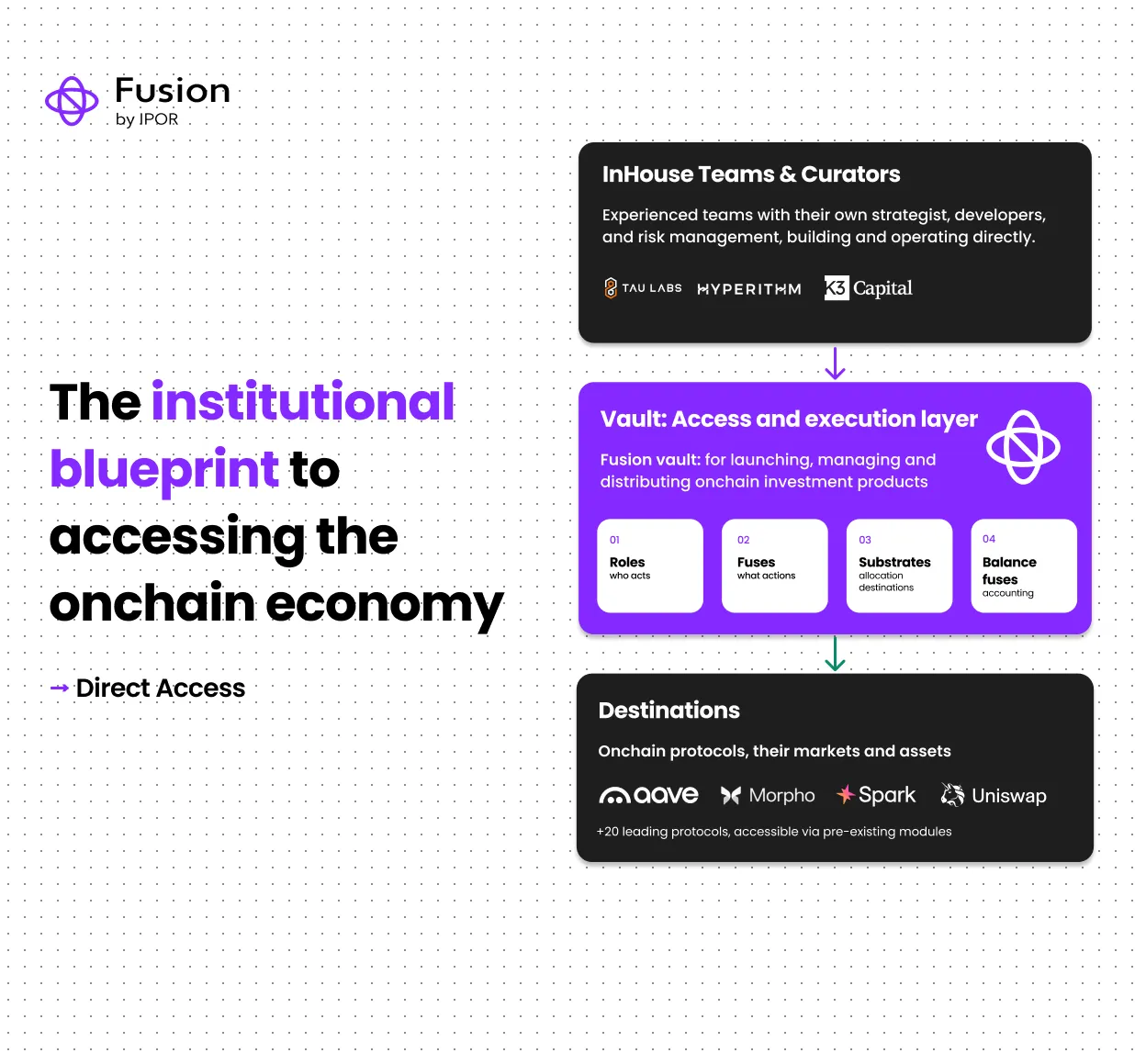
Teams with the capability in-house, an experienced development team, a strategist, and a risk manager, can build on Fusion directly. They configure the vault themselves, define its roles, permitted markets, and accounting, and deploy capital on their own terms, using the technology as the execution layer beneath their own strategy.
This path suits teams that want full control over the strategy and its parameters, and that have the internal expertise to operate a vault end to end. TAU Labs builds this way, running a cbETH looping strategy on Base.
“IPOR Fusion drastically reduces our operational overhead, allowing us to launch better vaults, faster. Building directly on Fusion infrastructure, we established the largest cbETH position on the Base network and grew Aave’s cbETH market by over 190% in a single month. Their team is always responsive and proactive in helping us optimize our strategies.”
 $100M+ TVM
What institutional capital can build
A route only matters for what it enables. Vaults on Fusion can be run with several distinct approaches, each with its own risk profile, each reachable through the same infrastructure.
Lending optimization
Capital is routed across lending venues and rebalanced as terms move.
Example: a WETH optimizer on Base holds positions across Aave, Morpho and Euler, and shifts allocation between them as borrow and supply rates move, staying within the venues named in its configuration.
Leveraged looping
A yield-bearing asset is supplied as collateral, borrowed against, and the borrowed asset is converted back into the same collateral and re-supplied, amplifying the spread between its native yield and the cost of borrowing.
Example: a vault supplies cbETH to Aave on Base, borrows ETH against it, swaps that ETH for cbETH, and supplies it again, repeating the cycle up to the leverage ceiling set in its configuration. The leverage ceiling, collateral ratio, and liquidation buffer are all fixed there.
Carry trades
A position is financed to capture a spread between two rates.
Example: a vault deposits rETH as collateral on Liquity, borrows the BOLD stablecoin against it, and supplies that to a Curve pool, holding the difference between the yield on the collateral and the cost of the debt.
Delta-neutral construction
Yield is produced while directional market exposure is hedged out.
Example: a BTC vault borrows against a yield-bearing Bitcoin position on Morpho, returning USD-denominated yield. Suited to mandates seeking return with limited market correlation.
Tokenized real-world assets
The same vault structure applies to instruments issued offchain and represented onchain.
Example: Fusion vaults support tokenized instruments issued by Midas, and extend to B20, Base’s native token standard for regulated assets and tokenized equities.
For an institution, all of it runs on one audited infrastructure. Diligence is done once and carries across every strategy built on it.
Verifiable onchain accounting, position by position
Access is only half the picture. The other half is knowing what the vault holds and what it is worth.
A vault working across Aave, Morpho, or Spark rarely holds one simple position. It may hold collateral in one market and debt in another, across several positions at once. The vault reads the value of each one directly from the protocol it sits in, nets it out, and converts it to a single USD figure. Every figure traces back to a live market position.
Example: in a leveraged cbETH position, the cbETH collateral is valued through its price feed, the borrowed ETH is subtracted, and the net worth feeds into the vault’s share price.
For an institution, every figure in the vault can be traced to its source. An allocator can see what the vault holds, what it is worth, and where that value comes from.
Onchain governance: rules that hold after capital enters
An allocation mandate is only as good as its enforcement.
In a Fusion vault, the mandate is the configuration itself: which venues the vault may touch, which actions it may take, and where liquidity may be routed. Those constraints are enforced onchain, at the contract level, from the moment the vault goes live.
Changes to that configuration can be placed behind a timelock. A scheduled change is visible from the moment it is proposed and only takes effect once the delay has elapsed, giving the client full sight of any adjustment to the mandate before it applies. A dedicated guardian role can cancel a scheduled change within that window.
This means the parameters agreed at launch remain the parameters in force, and every revision surfaces onchain before it applies. In the rare case where a change is unwanted, the delay leaves ample room to review it, cancel it, or withdraw entirely before it takes effect.
Vaults built to be verified by humans and agents
Every permission, market, and accounting rule lives onchain, which makes a Fusion vault legible to software as well as to people.
The full set of what a vault is allowed to do can be read directly from the chain and checked against a mandate before a single unit of capital moves.
The role model makes this safe to act on. Execution rights and withdrawal rights are separate, so a strategy can be operated by an automated system that has no path to client funds.
Automation gains speed without gaining custody.
This is what makes automated strategy management viable at institutional scale. A risk team can verify the boundaries of a vault programmatically and continuously. The same properties that allow an allocator to audit a vault by hand allow a machine to audit it in real time.
An open opportunity set, entered on institutional terms
Some of what happens onchain has no counterpart in traditional finance. Positions are transparent. Terms are verifiable.
And the primitives are genuinely new: a flash loan settles an unsecured borrow inside a single transaction, a construction with no equivalent in traditional finance, and strategies are composed from protocols that plug into each other by default.
The opportunity set is still expanding, and much of it is still thinly contested. What was missing was a way that met institutional standards for control, mandate, and accounting.
Fusion vault infrastructure is that way in, and it is also where the strategy lives. Liquidity is sourced from established protocols like Aave and Morpho.
Performance is built inside the vault: a looping strategy, a carry trade, an optimizer routing between venues, all executed under rules fixed before capital enters. The venues supply the market. The vault supplies the strategy, and the discipline it runs under.
More than forty onchain protocols and 170 distinct actions are reachable through pre-existing Fusion modules.
Build your first Pilot Vault
Scoping institutional access to onchain markets? Talk to the IPOR Labs team about a pilot vault configured to your mandate. Contact Us.
Related
- BitGo Opens Institutional Access to Tesseract’s Dedicated Client Vaults Powered by Fusion
- Tesseract Selects IPOR Fusion as Onchain Vault Infrastructure for Institutional Clients
- How Vault Curators Can Navigate MiCA in 2026
- Turning cbETH’s 2.75% Native Yield to 15% on Aave with Fusion Automation
- Covered Vaults Come to Fusion: Embedded Onchain Protection by OpenCover
- Base Rewards Now Live for Select Fusion Strategies via Anchorage Digital