1 Year of the Lido stETH Vault on IPOR Fusion: +5.50% in stETH, Automated Within Transparent Mandates

One year ago, the IPOR DAO introduced an automated strategy built around Lido’s stETH. It was designed to loop stETH across major credit markets on its own, and to produce more stETH than simply holding it for its participants.
Here are the results from the moment the strategy was ignited on November 21, 2025 until November 16, 2026.
Key performance takeaways
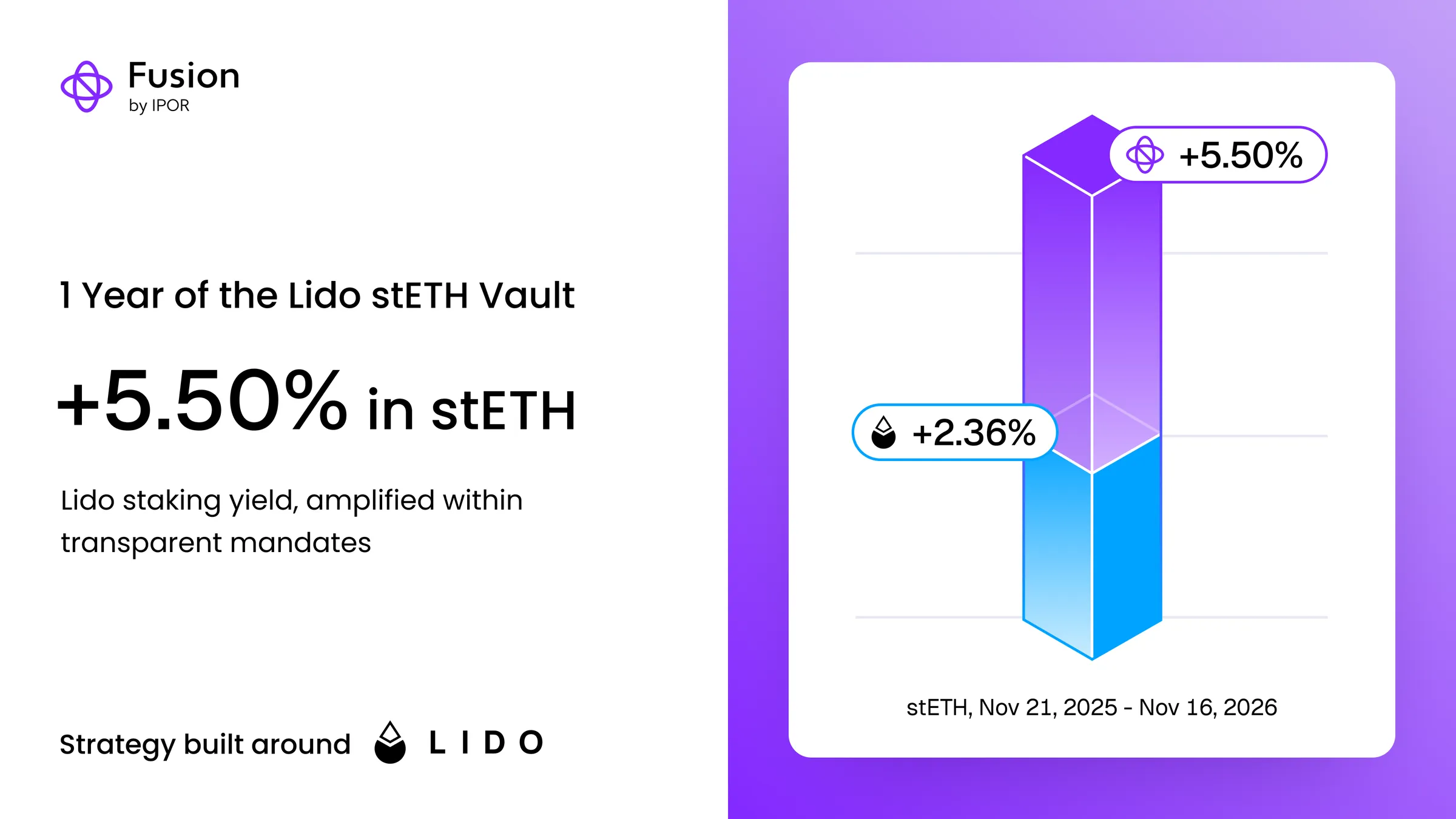
- The vault’s share price grew 5.50% in stETH after fees (Nov 21, 2025 to Nov 16, 2026), against about 2.4% from holding stETH alone
- The vault moved primarily between Spark, Aave and Morpho, within rules anyone can verify onchain
- One in three holders came back to add more stETH after first joining the vault
In this article
- Using the stETH Looping Strategy vs Holding stETH
- How Does the Vault Produce Yield?
- The Math Behind the Headline Rate
- Where Liquidity Moved to Optimize stETH Output
- Rebalancing Activity in Detail
- How the Vault Navigated the Kelp Incident While Keeping Exits Open
- Total Value Locked in stETH
- More Performance and Economic Activity Within the Lido Ecosystem
- Durable Strategies Powered by the Mandated Vault Infrastructure of IPOR Fusion
- Build on IPOR Fusion
Using the stETH Looping Strategy vs Holding stETH
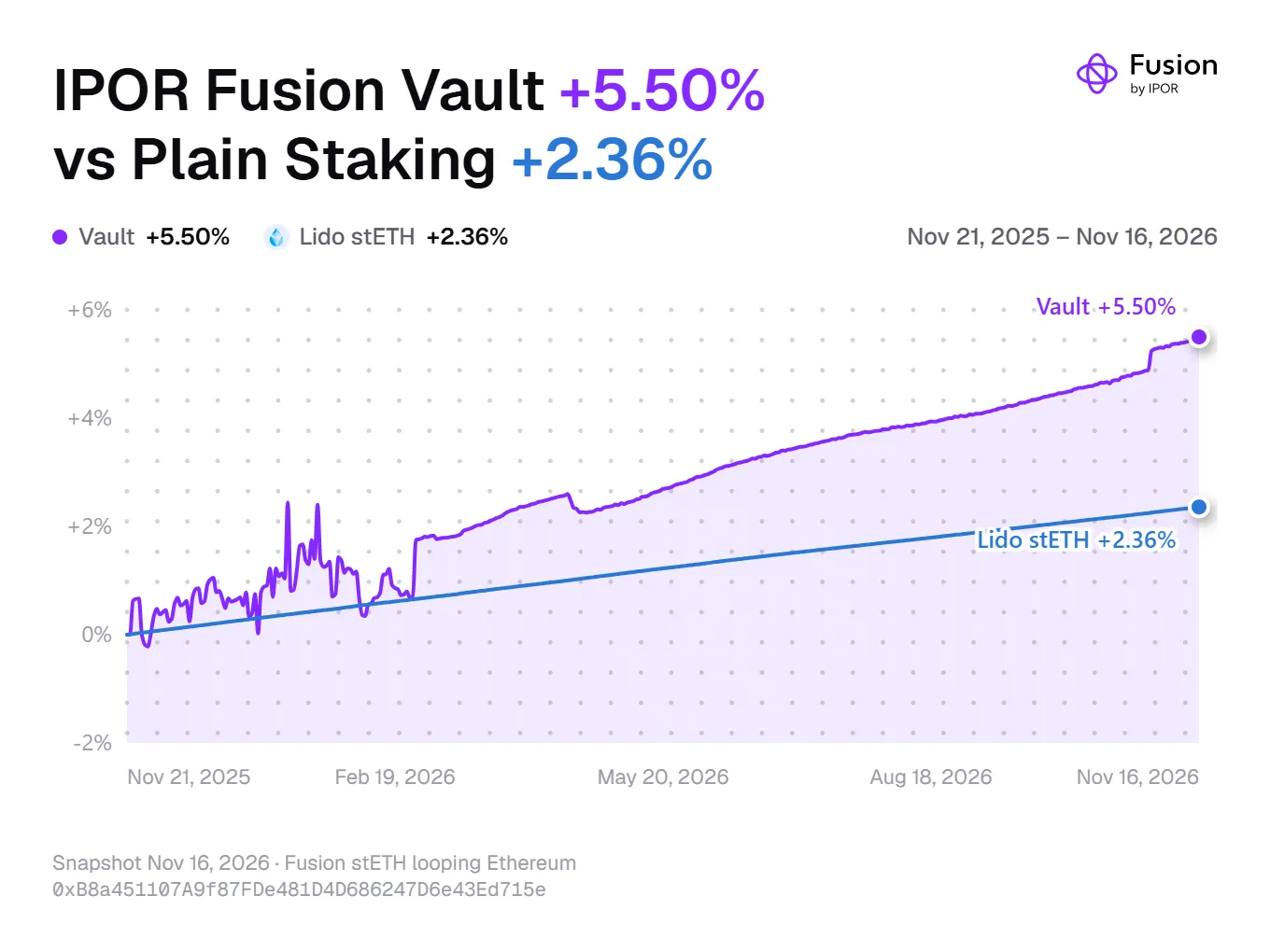
The chart above shows two scenarios. In the first (purple line), 1 stETH is placed into the IPOR Fusion vault. In the second (blue line), stETH is simply held in a wallet and earns plain staking yield.
We can see that over time, vault participants collected more stETH than they would have by holding it in a wallet.
You may also notice some sharp swings in the first months after the strategy was ignited. Back then stETH was valued at its market price, and these swings went away once the oracle was switched to fundamental pricing around Feb 25.
How Does the Vault Produce Yield?
The vault earns its yield through automated looping.
First, it supplies stETH as collateral on a credit market such as Aave, borrows ETH against it, turns that ETH back into stETH and supplies it again.
This process is repeated until the position is about ten times the size of the stETH originally placed in the vault, as the strategy targets a 10x loop.
Staked ETH usually yields a little more than ETH costs to borrow.
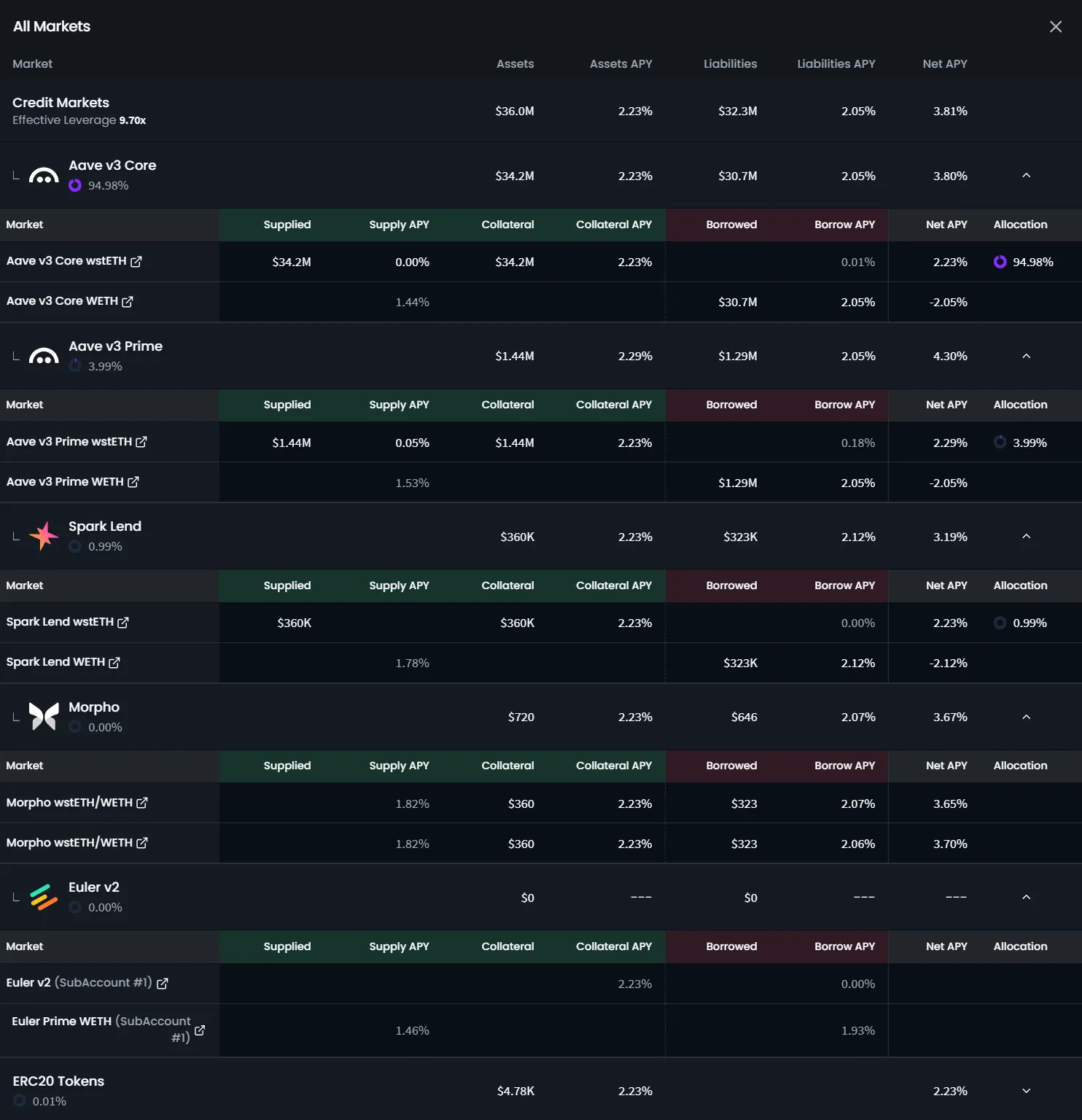
On Nov 17, 2026, for example, the vault’s stETH was earning 2.23% while its borrowed ETH cost 2.06%. That small gap, 0.17 percentage points in this example, is called the spread, and thanks to the loop it is earned on a position about ten times larger.
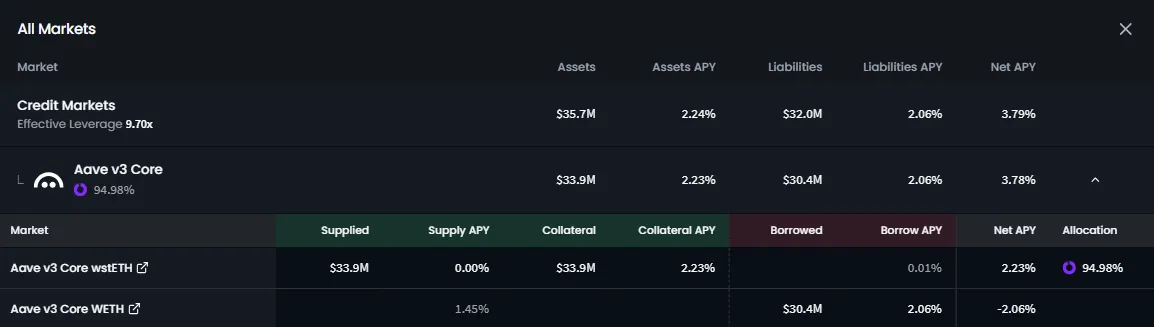
Source: IPOR stETH Ethereum, IPOR Fusion App
On the graphic above, we can observe part of the vault’s allocation breakdown, with Aave V3 Core currently serving most of the vault’s assets as it offers the most efficient rates at the time.
Key takeaways
- The yield comes from the spread between what stETH earns and what ETH costs to borrow
- Looping about 10x multiplies that spread, on top of the regular staking yield
- When the spread narrows the vault earns less, and it can move to another market when the terms there are better
The Math Behind the Headline Rate
The vault’s result is made of two parts. The first is the regular staking yield, earned on the stETH placed in the vault. The second is the spread, earned on the extra stETH that the loop adds on top.
Using the Nov 17 figures, with the loop running at 9.7x (close to the 10x target), the math looks like this:
- Staking yield on the original stETH: 2.23%
- Spread on the looped stETH: 0.17 × 8.7 = about 1.48%
- Together: about 3.7% a year, before vault fees
Note: that is the snapshot as of Nov 17, 2026, and it is lower than the 5.50% the vault delivered over its first year.
The reason is that the spread changes every day as credit markets shift, and for much of 2026 it was wider than 0.17.
Working backwards from the year’s result, the vault earned about 3.1 percentage points on top of plain staking, which comes to an average spread of roughly 0.35 points across the loop, after fees.
At any time, the IPOR Fusion App shows a granular breakdown of the vault’s underlying credit markets and how its rate is produced.
The same figures can be read independently onchain by anyone.
Source: IPOR stETH Ethereum, IPOR Fusion App
Key takeaways
- The headline rate has two parts, the staking yield on the original stETH and the spread on the looped stETH
- At the Nov 17, 2026 rates the math gives about 3.7% a year, while the first year’s 5.50% reflects a wider average spread
- Small changes in the spread matter, because the loop multiplies them about nine times
Where Liquidity Moved to Optimize stETH Output
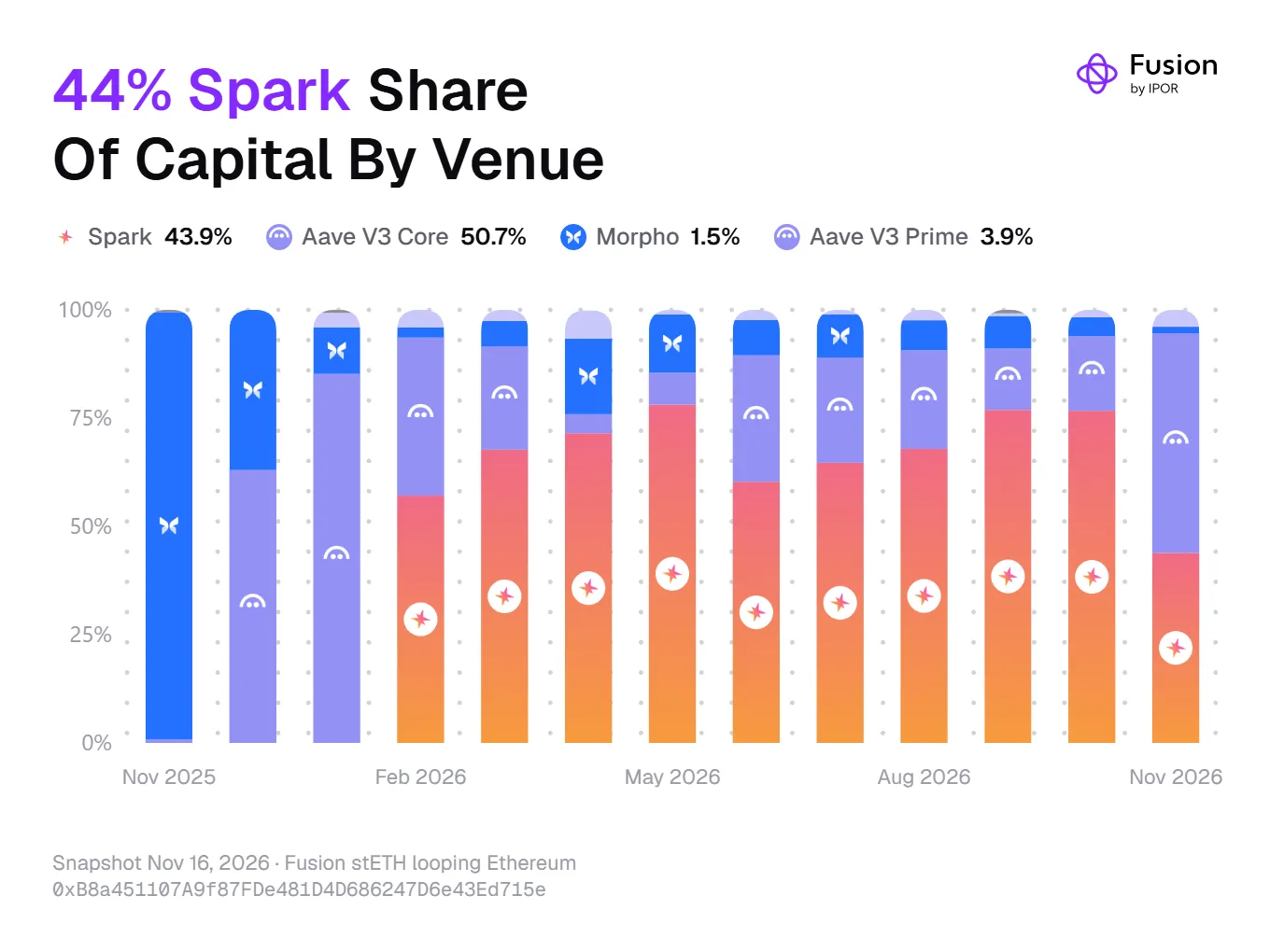
The chart above shows how the vault’s stETH position was split between credit markets in each month since launch.
In the first weeks, almost everything sat on Morpho. By December, most of the position had moved to Aave V3 Core.
In February 2026, Spark joined the set of markets available to the vault. From that month on, it absorbed the largest part of the vault’s position in most months.
The reason behind these moves goes back to the spread, the gap between what stETH earns and what ETH costs to borrow. It is different on every market and changes daily, and the automation moves the position to the market offering the most efficient rates at the time.
Morpho held under 10% of the position on average, yet it was in use about 85% of the time. After those first weeks, the vault has used Morpho primarily for flash loans (loans taken and repaid within a single transaction) when switching between credit markets such as Aave and Spark.
Key takeaways
- Over the full year, Spark held about 61% of the position on average and Aave V3 Core about 27%
- The vault moves when another market offers a better spread, and its main market changed 34 times
- Morpho is used primarily for flash loans when the vault switches between markets
Rebalancing Activity in Detail
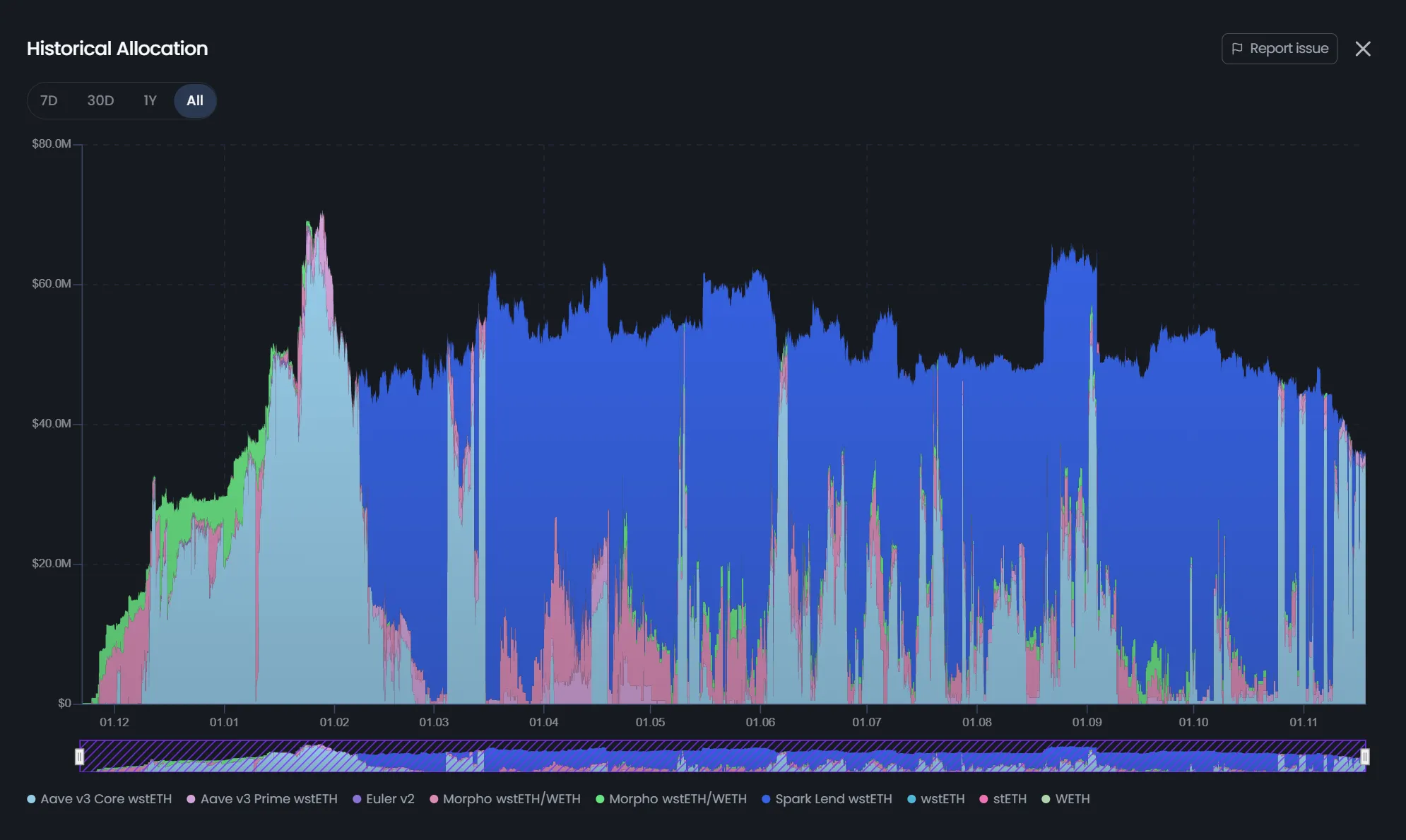
Behind the results, the vault was busy almost every day. Over the year it supplied about $5.8 billion of collateral to credit markets, cumulatively. That is about 2.7M stETH-equivalent, or roughly 1,190 times the vault’s average size of 2,260 stETH.
It helps to know how this number is counted. It adds up every hour in which the vault’s collateral on a market grew.
That includes new stETH being looped, positions landing on another market after a rotation, and the short passes through Morpho when the vault switches markets. Each of these is a separate transaction onchain, which is why the total is far larger than the vault itself.
Over the same hours, the vault borrowed about $5.2 billion of ETH.
A more detailed hourly visual breakdown is available in the IPOR Fusion App, as seen below.
Key takeaways
- The vault supplied about $5.8 billion of collateral over the year, cumulatively, roughly 1,190 times its average size
- Spark took in $2.00B of it, Aave V3 Core $1.97B, Morpho $1.42B and Aave V3 Prime $0.36B
- The total counts every separate move onchain, which is why it is far larger than the vault itself
How the Vault Navigated the Kelp Incident While Keeping Exits Open
On April 18, 2026, an exploit of Kelp DAO’s rsETH bridge put pressure on ETH credit markets. Aave froze its rsETH markets, and the cost of borrowing ETH jumped across markets.
The vault held no rsETH and had no exposure to the affected markets. Still, on the same day it unwound its whole position on Aave V3 Core, and by April 19 most of it was sitting on Spark, where ETH liquidity was deep at the time.
The incident did leave a mark. Requests to exit the vault were queued for about a day while ETH liquidity returned to the credit markets, after lenders had withdrawn it during the incident, and the vault’s rate dipped below zero for a short time because of the higher borrowing costs.
By April 27, the vault’s rate was back to its usual levels.
Throughout the incident, the vault was never paused. The IPOR Fusion vault architecture allowed participants to request an exit at any time.
Key takeaways
- The vault had no exposure to the affected rsETH markets
- It moved off Aave V3 Core on the day of the exploit and shifted to Spark by the next day
- The vault was never paused, and participants could request an exit at any time during the incident
Total Value Locked in stETH
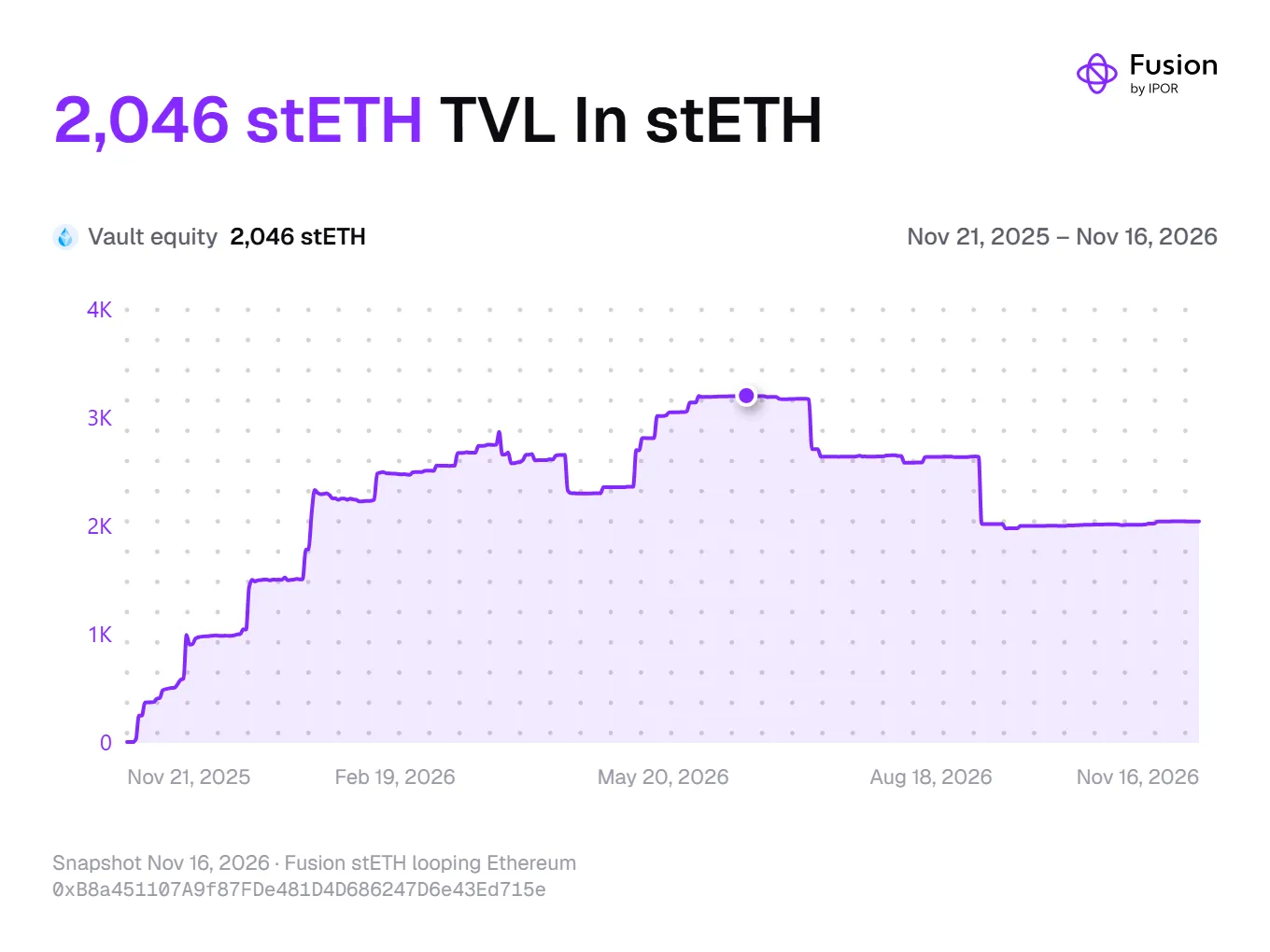
The chart above shows the vault’s Total Value Locked (TVL), measured in stETH, since launch.
The vault started with 7.8 stETH and holds 2,046 stETH as of 16 Nov 2026. Its highest point was 3,209 stETH on June 18, 2026.
Over the year, about 4,692 stETH was added to the vault and about 2,670 stETH was taken out.
In dollars, TVL was highest at $7.0M on Jan 28, 2026 and was $3.7M as of Nov 16, 2026. The dollar value also moves with the price of ETH.
Looking at the chart, we can observe three patterns.
First, the highest point in stETH came five months after the highest point in dollars. Participants kept adding stETH while the dollar value of the vault was falling, which suggests they measure their results in ETH.
Second, capital came back after the Kelp incident. TVL dipped in mid-April 2026, and two months later it reached its highest point of the year.
Third, between the larger moves TVL stays flat for weeks at a time. stETH placed in the vault tends to stay there, with an average holding time of about six months.
Key takeaways
- TVL grew from 7.8 to 2,046 stETH, with a high of 3,209 stETH on June 18, 2026
- About 4,692 stETH was added over the year and about 2,670 stETH was taken out
- Capital came back after the Kelp incident, and stETH placed in the vault tends to stay for about six months
More Performance and Economic Activity Within the Lido Ecosystem
For holders of Lido’s stETH, the vault adds a second layer on top of staking. stETH that would otherwise sit in a wallet is put to work across credit markets.
This works in two directions for the Lido ecosystem. It activates stETH that already exists, and it gives ETH holders a reason to move into stETH. Over the year, 194 participants placed about 4,692 stETH in the vault, and one in three came back to add more.
The loop itself also creates demand for stETH, because every ETH the vault borrows is turned into stETH. At its peak on June 18, 2026, with 3,209 stETH in the vault and the loop running at close to 10x, the vault held roughly 30,000 stETH across credit markets, worth over $50M at the time, against about $5.6M of stETH placed by participants.
Key takeaways
- The vault puts existing stETH to work and gives ETH holders a reason to join the Lido ecosystem
- Every 1 stETH placed in the vault kept about 10 stETH at work across credit markets
- At its peak, about $5.6M of participants’ stETH supported a position worth over $50M, of which over $45M was additional stETH demand created by the loop
Durable Strategies Powered by the Mandated Vault Infrastructure of IPOR Fusion
A year of results says as much about the vault infrastructure as it does about the strategy. The automation was active on 356 of the year’s 361 days, rebalancing across credit markets whenever the economics shifted. The vault’s main market changed 34 times over the year.
It went through the Kelp incident, which rippled across the onchain economy, and the vault was never paused. Since the day the strategy was ignited, participants could request an exit at any time.
This comes down to how IPOR Fusion vaults are built.
First, the vault’s capital can only move along the rails defined in its mandate, which sets the markets it may use and the actions it may take there.
Second, IPOR Fusion vaults can apply an offboarding contribution, which covers the cost of unwinding the position and stays in the vault. That cost is carried by the participant who leaves, which protects those who stay and is part of what lets the vault keep exits open during stress.
Every part of this report can be verified independently. The vault’s mandate and each move it has made are readable onchain at 0xB8a451107A9f87FDe481D4D686247D6e43Ed715e, and through the IPOR Fusion MCP toolkit, which reads the same onchain data.
Build on IPOR Fusion
Over one year, the stETH looping vault moved about $5.8 billion of collateral across credit markets, cumulatively. Every move stayed within a pre-defined mandate that anyone can verify onchain.
IPOR Fusion’s smart contracts are audited, and onchain threat monitoring from Blockaid is live across a first set of IPOR Fusion vaults. The same vault stack is used by regulated entities, with a Fortune 500 custodian and an ETP issuer reaching the onchain economy through our infrastructure.
The stETH looping vault is one example of what can be built on it. The same infrastructure is available to operators, developers and institutions who want to run their own strategies within transparent mandates.
Materials to get started:
- IPOR Fusion documentation
- IPOR Fusion Python SDK 4.0
- IPOR Fusion AI vaults
- The stETH looping vault in the IPOR Fusion App
You can also get in touch through the contact page, or reach out to the founders, Darren Camas and Dimitar Dinev, who can assist with the technical setup and onboarding.
Data as of 16 November 2026 unless stated otherwise.
Disclaimer: This article is for informational purposes only and is not financial, investment or legal advice. The figures describe the past results of one vault and do not indicate future results. Participation in any onchain vault carries smart contract and market risk.