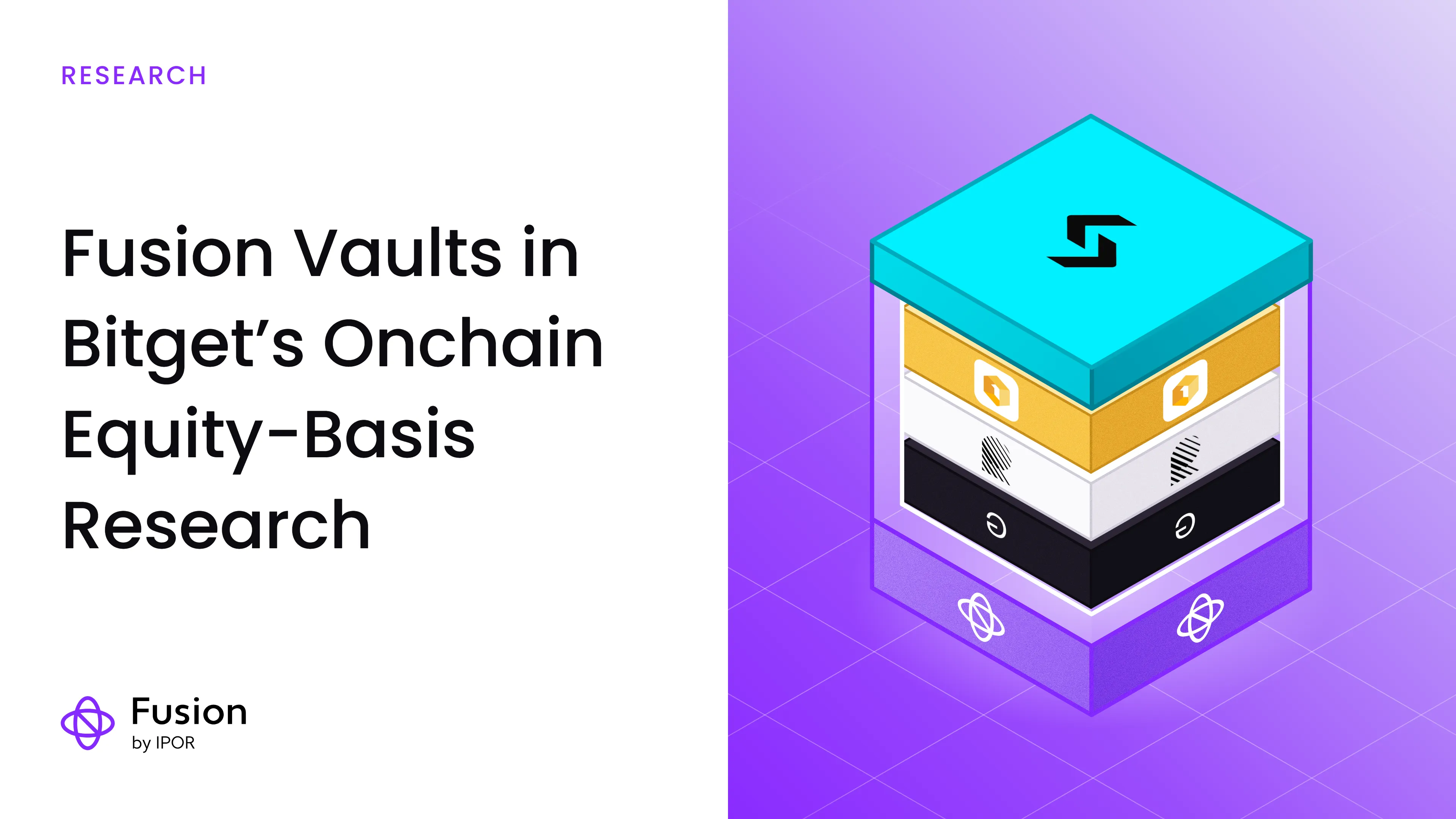
125M+ User Exchange Bitget Names IPOR Fusion Vault Infrastructure in Its Equity-Basis Research

TL;DR
- Bitget, Keyring and Reality published research on bringing the equity-basis trade onchain, using Reality’s tokenized equities (rTokens).
- The report names IPOR Fusion as the vault infrastructure enforcing the strategy’s rules: permitted assets, authorized markets, risk limits and execution rules.
- Selected products are planned for Bitget Earn, subject to Bitget’s product review, regulatory requirements, eligibility and availability.
Bitget, a leading crypto exchange serving more than 125 million users, has published research with Keyring and Reality on decentralizing the equity-basis trade.
Announced through GlobeNewswire and on the Bitget blog, the report sets out how tokenized equities, onchain lending markets and perpetual hedges can be combined into a rules-based strategy, with each piece run by a separate protocol.
IPOR Fusion is the vault infrastructure in that stack. In the report’s words, Fusion “applies predefined investment mandates through smart contracts, enforcing permitted assets, authorised markets, risk limits and execution rules.”
How the setup works
The equity-basis trade aims to collect funding paid by long positions to shorts. Where funding on an equity perpetual is positive, a trader holds the stock and shorts its perpetual. The two legs offset price exposure, and the position earns the funding spread.
The research splits that trade across five components:
- Equity leg. Reality’s rTokens give onchain exposure to listed equities. They can be bought through Bitget Exchange, Bitget Wallet or Reality’s request-for-quote service.
- Financing. rTokens are posted as collateral in onchain lending markets structured by Keyring. Stablecoin lenders supply the pool, and the strategy borrows against its rTokens to fund a larger position.
- Hedge. The matching short sits in an equity perpetual on Hyperliquid, offsetting the stock-price exposure of the rToken leg.
- Liquidations. Keyring’s [un]wind product, connected to Reality’s RFQ, coordinates collateral redemption and debt repayment if a position needs to be unwound.
- Monitoring. 1Token brings the rToken holding, the perpetual hedge and the collateral into a single portfolio view, tracking PnL and margin across protocols.
On top of these components, Keyring has built a rules-based index that ranks basis opportunities and allocates capital under predefined liquidity and risk constraints. The same building blocks can also be used on their own, letting managers construct their own strategies around individual rToken pairs.
Where IPOR Fusion fits
A rules-based strategy is only as reliable as the way its rules are enforced. In the research, that job sits with IPOR Fusion:
IPOR’s Fusion vault infrastructure applies predefined investment mandates through smart contracts, enforcing permitted assets, authorised markets, risk limits and execution rules. This made the strategy fully programmable while keeping implementation tightly aligned with the rulebook.
The report’s lending-market design also shows a Fusion vault on the stablecoin side: lenders deposit into the vault, which supplies the stablecoin market that borrowers draw on against rToken collateral.
In practice, each Fusion vault’s rules are set in its configuration and enforced onchain:
- Permitted assets and markets. A vault can only interact with the assets and markets its configuration allows.
- Risk limits. Position limits are part of the vault’s setup, so allocations stay inside the mandate.
- Execution rules. The operator executes within those limits, and every allocation can be verified onchain.
This is the same model behind the IPOR Fusion vaults supplying tokenized stocks to Aave V4 on Base. Operators define the rules once, the vault enforces them, and anyone can check the result onchain.
In their words
Tokenised stocks are opening up opportunities beyond buying and selling shares. Investors can use them as collateral, combine with derivatives, and integrated strategies that previously required separate financial platforms. This research shows how those pieces can work together, while highlighting the importance of execution costs, liquidity and risk management. That is an important part of what we’re building with Bitget’s Universal Exchange.
Bringing the equity basis trade fully on-chain makes a strategy traditionally run by asset managers more transparent, programmable and accessible to a broader set of investors. More importantly, the index creates a benchmark and set of building blocks that investment banks, fund managers and CTAs can use to develop their own strategies.
The modularity, flexibility, and institutional rigor of the IPOR Fusion stack open up new ways to put tokenized equities to work, from lending markets to rules-based equity-basis strategies. Together with Keyring, Reality and 1Token, we look forward to supporting Bitget Earn’s planned onchain products as they take shape, with every rule enforced in the vault and every allocation verifiable onchain.
Why decentralizing the basis trade matters
Equity-basis strategies have traditionally run on centralized exchanges, where custody, execution and margin sit with one intermediary. The research points out that this concentration brings counterparty and operational risk, and that past failures of large centralized players have increased interest in structures that separate these functions.
Splitting the trade across specialized onchain protocols keeps each function independent: Reality issues the equity exposure, Keyring structures the lending and index, Hyperliquid hosts the hedge, 1Token monitors the portfolio, and IPOR Fusion enforces the mandate.
The report is also clear about the trade-offs. Running across protocols adds smart contract, bridge, oracle and liquidity risks, and gains on the perpetual hedge do not automatically offset changes in collateral value in a separate lending market. It highlights coordinated margin management, reliable price feeds and sufficient liquidity as the core requirements.
What comes next
According to Bitget, selected products informed by the research are planned to launch through Bitget Earn, subject to product review, regulatory requirements, user eligibility and availability.
Read the full research from Bitget, Keyring and Reality: Decentralising Equity Basis with rToken
Data as of 28 October 2026.
Sources
This article summarizes third-party research for information only. It is not investment, operational or financial advice. Products referenced are planned by Bitget and remain subject to its review, regulatory requirements, eligibility and availability.